

Today, I write with a story from darkness to light, being defined to re-defining, and uncertain fear to enlightenment.
I acknowledge that I’m not always strong through my journey with grief; that the laughter and comedy, which is my usual medicine, aren’t always a cure.
I hope with anyone’s journey through grief you know that your experience does not define you, and what people say aren’t applicable as your identity. Most importantly, what your mind tells you “is true,” whether it’s from your words or someone else’s; it is not a fact.
Understand that grief isn’t a permanent state of darkness, anger and tears, or the idea of swimming in a swamp swimming amongst the tics, snakes and gators. It is the good and the bad. It is the grotesque and the beautiful. It is the dark and light. Grief isn’t, and never was, a three-week mark, Amazon Prime delivery, “it’s over,” and “move on” idea. Grief is the absolute recognition of someone we love with our entire heart. It is the ultimate recognition that you loved during your life.
We will all experience loss of some kind. There is the loss of control of a situation you’d believed you had handled. Financial loss, loss of career, or a beloved pet or family member. It alters the mind and our emotions.
Last Tuesday, I felt reasonably content heading into the holiday season. My family made plans. We celebrate around a tree in a turn-of-the-twentieth century parlor room.


I was in a content mood on Tuesday, and planned to take my students outside to play kickball. Then just as quick: one instance and simple words ripped it all apart.
I do not write this to review the situation, or to state why it shifted my emotions. I went silent as I often do in anger, sadness, or depression. I lost all desire to go outside. My students reminded me in their excitement, and we went.
But all contentment I’d worked hard to re-obtain in my life, and believed I’d never feel again vanished with words. Within the event, there was an unforeseen trigger.
As a result, I stayed home the following day. I didn’t eat for about 48 hours, and was stuck in a trance my husband tried to bring me out of with his positive energy. I didn’t lose my temper nor cry. I just stayed silent. I was back to the type of numbness I felt the moment Corrie died.
1. Thoughts are Thoughts; Not Sharks
Thoughts circle in our mind, and when they swirl as a hurricane enough, we believe them. Those negative thoughts swim around our identity like sharks. These thoughts might come from what others say or ourselves. One book I’ve used in the past to help me, and I’m re-reading is 10% Happier: How I tamed the Voice in my Head … by Dan Harris, who used to be on Good Morning America.
These fearful forecasts were just thoughts skittering through my head. They weren’t irrational, but they weren’t necessarily true … I was able to see my thoughts for what they were: just thoughts with no concrete reality.”
On Tuesday and through Wednesday night, I’d entered a dark place. My parents knew it from my husband, and Christmas seemed like it was going to be canceled in our house. Remember, it’s easy to ask: Didn’t you remember your son? Didn’t you see how your husband was trying to help you? It’s easy to ask those questions until you experience grief, loss, mental health, depression or PTSD. My thoughts and fears ate away at my identity little-by-little gradually making me believe I was a horrid this or that.
But I decided to go out, and check Corrie’s grave. I needed to get a few items. A switch went off in me when I saw a small LED candle on Corrie’s grave for the lights’ display done at her cemetery for Christmas. I’d had a share of struggles at the cemetery, but the staff and I have made peace. The fact they thought of her meant more than words could express.

Seeing my daughter as being honored instead of forgotten perhaps rescued me.
After this, I journaled more than I have in two years combined. I wrote through the emotions first, what had happened, my thoughts on it, and the causes. Then I moved forward with understanding I cannot control the future, but I can do something, as Harris wrote for the long title of his book: “how I tamed the voice in my head.”
Whenever something hits me hard, I have my initial reaction, and then I step back to learn from it. Throughout my journal, it went from emotional to reflection to forming a plan. Part of it included dealing with the untamed voice in my head; little monsters that come from where the wild things are.
2. Making a Plan
I’m the kind of person who looks a trigger blow in the face, and then asks: Okay, what are you going to do about it? The one strong example I had occurred one-year-and-a-half before I lost Corrie when I was going through a different difficult time. I started doing Yoga, and read Dan Harris’ book. I committed to it from November 2018 until I got very sick in April 2019, and I was not eating.
While I got sick, I wouldn’t have made it for as long as I had without Yoga, and the help of Harris’ book. But, I didn’t finish Harris’ book.
More than understandably, everyone who grieves does so differently, and might not feel the need nor ready to make a plan.
Beginning Wednesday night after I saw the LED candle at Corrie’s resting place, I decided to make a plan to re-fortify myself, so I’m as emotionally equipped as possible to handle unforeseen triggers. Most importantly, I recognized the need to build my peace-of-mind, and support my body in the process. At the end of the day, it’s good the situation occurred, because it pushed me toward something I’d needed to do in supporting myself.
The problem had become that I was pushing memories and emotions away rather than dealing with them before they were triggered because I didn’t want anyone to look at me as weak. Harris writes: “When you’re cut off from your emotions … they manifest in your body.”
I planned to read Harris’ book completely, bought and am also reading Yoga for Grief and Loss by Karla Helbert (who lost her son), started journaling alongside what I read, and re-committed myself to a way of life with Yoga.
Before now, I’d had a mental block of re-committing to Yoga because I’d started originally the night before Corrie died. She was in the room with me.
3. Eliminate the word, “Fix”
When I started reading Helbert’s book, this was–and is– meant to aid the spiritual, grief and physical part of my struggles. Something she writes that I found extremely important is the fact that Western society is uncomfortable with grief. People, whether family, co-workers, or friends; might see grief as something that needs to be swept up carefully like glass which breaks. The pieces are everywhere.
People are quick to make suggestions. They want to say something to make it better. Personally, I’ve had. overall, amazing support from the people in my life. I’ve only lost a few people from my life. If people cannot understand.
After a loved one dies, society wants us to go pretty quickly back to our pre-grief habits, our routines, our level of functioning, our activities; in general, back to who we were before we were suffused with grief.”
Yoga for Grief and Loss by Karla Helbert
Helbert writes that one of the biggest misconceptions in dealing with people who are walking through grief can be “fixed” whether through therapy or suggestions. She writes that telling a person to “stop being so overt” about it, or “‘fix’ the problem … frequently do cause a grieving person to feel even worse.”
So, what do we, those who grieve, do?
Only each of us can walk through our individual journeys. Each is different from the next one. For my journey, I know that I can’t “fix grief,” but the first step is acceptance. I accept that my life is forever changed by the unimaginable loss of my daughter. My relationship with her is different.
Then I look at the ways I can care for myself mentally and physically to aid me throughout this lifetime journey.
4. Do Something Physical
The people who saw my true state on Tuesday and Wednesday, only my husband and son, would never believe I’d dance with my oldest child with his new Nintendo Switch with Just Dance 2023 on Christmas Day.
For two-and-a-half-years, I’ve preached about the difference Yoga makes in one’s life based on my previous experience. But I’d do half-hearted starts without doing the reading and journaling that went with it in 2018-2019. I could not make it a way of life when the last time I’d done it was with Corrie the night before she died.
I never invited in the light, not to sound corny, back with Yoga. I’d originally started Yoga to lose weight after breastfeeding Corrie. I have torn cartilage in both knees, so I should not run at all. Doing squats caused my right knee to swell, thus Yoga entered my life.
I don’t need a gym membership. (I’m not crazy about being around people for long periods of time anyways.) YouTube is great, and does take up enormous amounts of space like the latest at-home gyms. I’ve found, more important than writing my memoir and poetry about Corrie, I need to move to ease my mind, invite in light and enlightenment.
Two activities I started doing recently include my true re-commitment to Yoga, and working through the grief with it. I did Yoga for an hour on Christmas Eve and for about forty-five minutes on Christmas Day. I’ll do it again today.
The second activity I started a few weeks ago involved creating table top Christmas trees. Thus far, I’ve made six. Two I made included Corrie’s dolls.
But it’s not just doing a Yoga routine, but committing to the reading about the positions, what they do for you and including meditation. This is where Dan Harris’ book enters. Put aside the back-to-back life challenges of a tornado, COVID-19, Corrie’s sudden death, the loss of Corrie’s dog, a miscarriage and John’s cancer; I am diagnosed with ADHD. I either become hyper focused on something, including those negative thoughts, or I fail to focus.
His first book is a memoir about how he found his way to meditation, and it is at times funny. It also contains a lot of truths to help calms those negative parts of our mind. It’s important to read these books, or books of your choice, along with your physical exercise to understand those negative thoughts are not you.
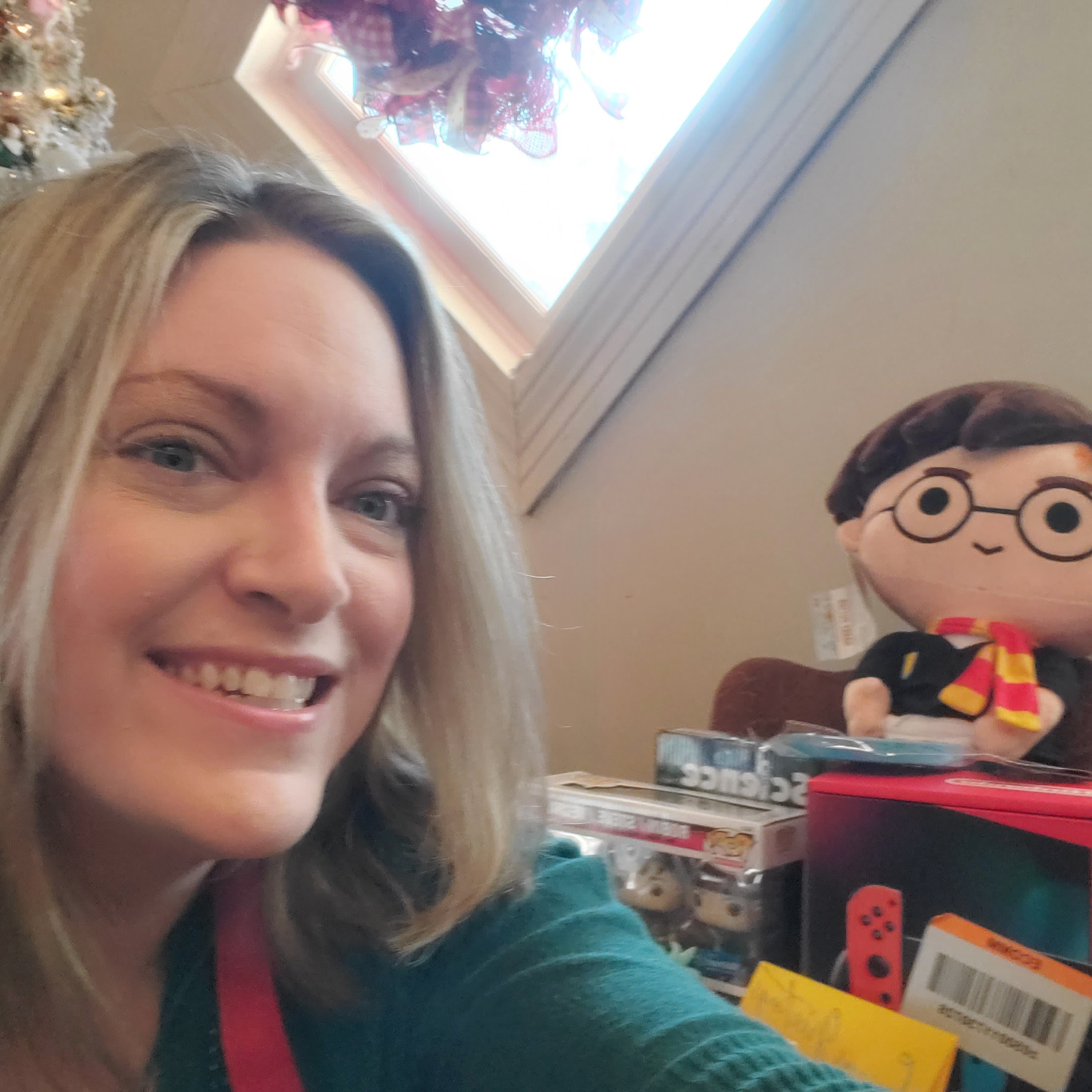
The transformation of my mind being in a chronic, depressive state, and not eating to reflection and re-building my confidence through the books, journaling, and Yoga led me to feel real joy on Christmas Day. It’s apparent in my face, wearing my grandmother’s apron, seeing my husband carve the turkey, and dancing very poorly with my son for Just Dance 2023.


5. Acceptance
The word, acceptance, contains a misconception in grief. It sounds final, as if you’re letting go, or you forever leave behind. To me, this is not what acceptance on the journey with grief means. Acceptance means you go stage-by-stage to accepting what you cannot change. It means you treat yourself with peace. It means that it’s okay to laugh again.
I accept Corrie is gone, and she’s not coming back. This does not mean her memory, or my relationship with her is gone. I accept that I can find new ways to celebrate her life. I accept it is just fine to talk about her life. She is always my child.
I accept I’m not defined by my grief, nor the negative thoughts in my mind. I accept I’m not identified by someone else’s perception.
During the first holidays after Corrie graduated to heaven, I wrote a poem called Unlit. Since then, holiday lights, or any lights in winter, have come to mean so much to me. The brighter–the better. I will sometimes look out of the window at the lights in her garden seeing the beauty and brightness of her garden and life.
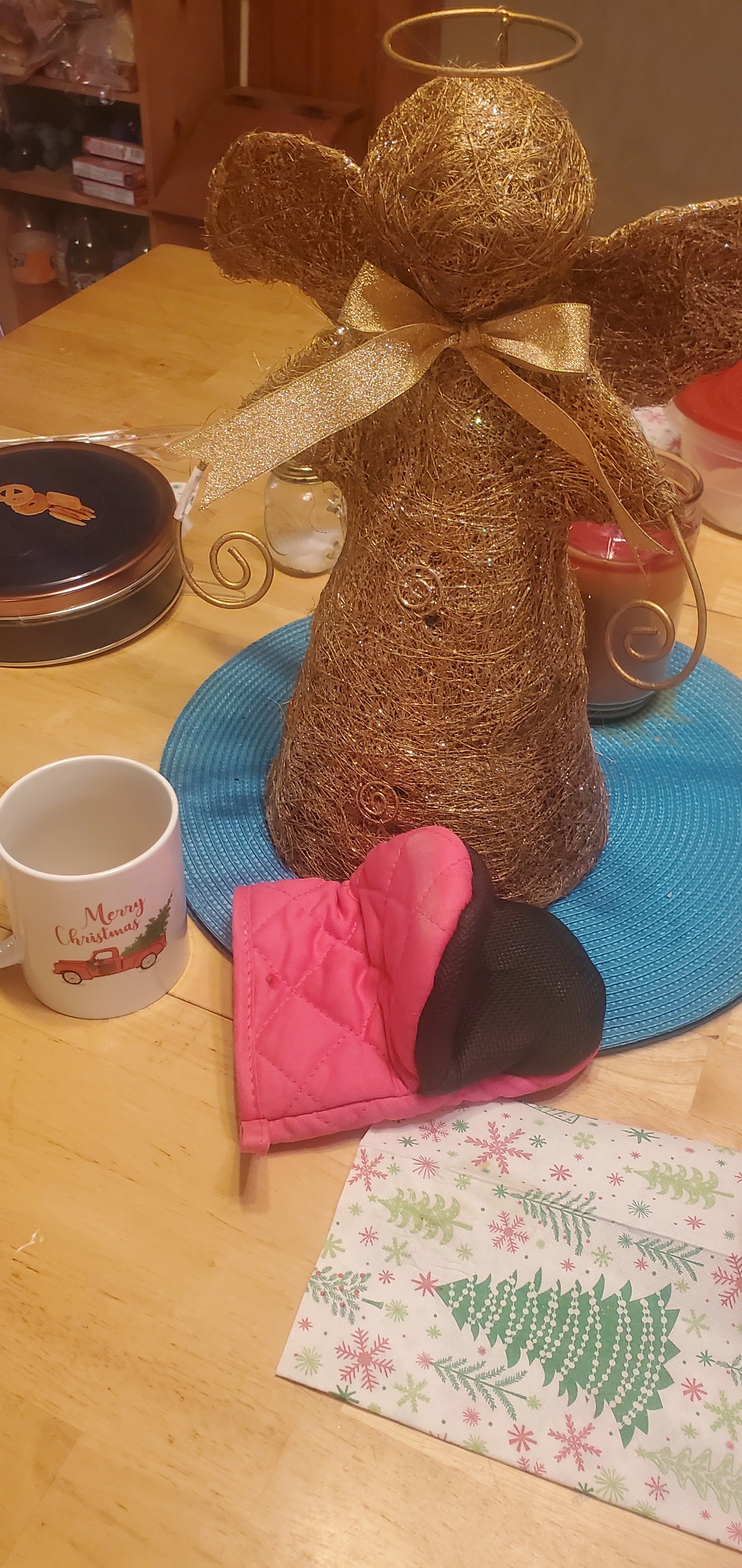
At the end of Christmas Day, I was sorting through items when I found a final gift from Corrie. I did not remember it. I have an idea of the birthday part from which she got it. But a small, pink hot mitt seemed to have fallen from heaven. It wasn’t in that area earlier. The mitt could’ve only belonged to one person.
If I could offer you any gift during this holiday season, it’d be the hope to find your light in grief.
For Further Interest in Help through Grief/ Depression
I also love, love the YouTube channel, Yoga with Adriene. Her voice always calms me down.
For a variety of great work outs and stretches, check out another favorite, Keaira LaShae.
Dan Harris has a second book, and website with Podcast for “10 Percent …”

 Corrie's Season
Reblogged this on Corrie's Corner and commented:
One of the most challenging parts of being a teacher is the journey on which I’ve been through grief. There are ways to find light in grief.
Grief can be a challenging and overwhelming experience, and it’s not always easy to find moments of light and hope in the midst of it.
I found the tips and suggestions offered in this post to be very helpful and practical. The idea of finding small moments of joy and gratitude, even in the midst of grief, is such an important one. It’s easy to get caught up in the darkness of grief and forget to focus on the good things in life.