
I will write publicly and in some depth about faith today. I hope it is the only time.
I hope that it will hold true.
Why It is Difficult to Speak/ Write about Faith
It may not hold true because I have written in short spurts about the difficulty in speaking or writing about Christian faith. It is harder for me to speak about it, debate, or find the right words because I dislike confrontation—my mother and father’s daughter in that respect.
Being neurodivergent, I also believe that I lack the confidence or correct words for a deep dive, unless I truly know someone.
I am currently reworking a poem I wrote after Corrie’s sunset I called “So I Write.” This version is still a work-in-progress because it deals with the trauma I have faced and with which I am attempting to make peace. This is the first verse in “So I Wrote”:
If I had one superpower, it would be to always
say or respond with the right words in the
correct moment, or to express my concern
if there is something to discern or to not feel
as a child needing a lesson when I
disagreed with words in their entirety.
If only this part of my mind were unlike
puzzle pieces tossed about in a ziplock bag instead
of still being in their original box. Something’s off,
but I was off from the time I was a child
inspected and questioned. I was not the
new polished silver taken out for Christmastime.
and I knew what alone and loneliness were before
I could write the words; running away in the
gym at age five because I could never say
the right words at the correct time any more
than I would express my discomfort at words
I discern as wrong because the child in me
wanted a friend, so I learned to write.
~excerpt verse from "So I Wrote," R.A. Bridges
Since witnessing the sunset of my daughter’s life, my faith stayed in a state of limbo.

It never led me towards atheism nor back through the doors of a church. I have reviewed scripture I know well from being raised in the United Methodist Church, and questioned. But I did not exit anymore than I re-entered.
The Example Set by my Grandparents
I recall performing with my state’s United Methodist Church choir at its retreat in the North Carolina mountains. I sat down next to my maternal grandmother, “Mimi,” as we observed a few people walking to the front for an alter call.
“I don’t like that,” Mimi said. “People don’t have to flaunt their faith so publicly.”
Both sets of grandparents said little in regards to faith, while showing core Methodist beliefs, which includes faith through example and missions.
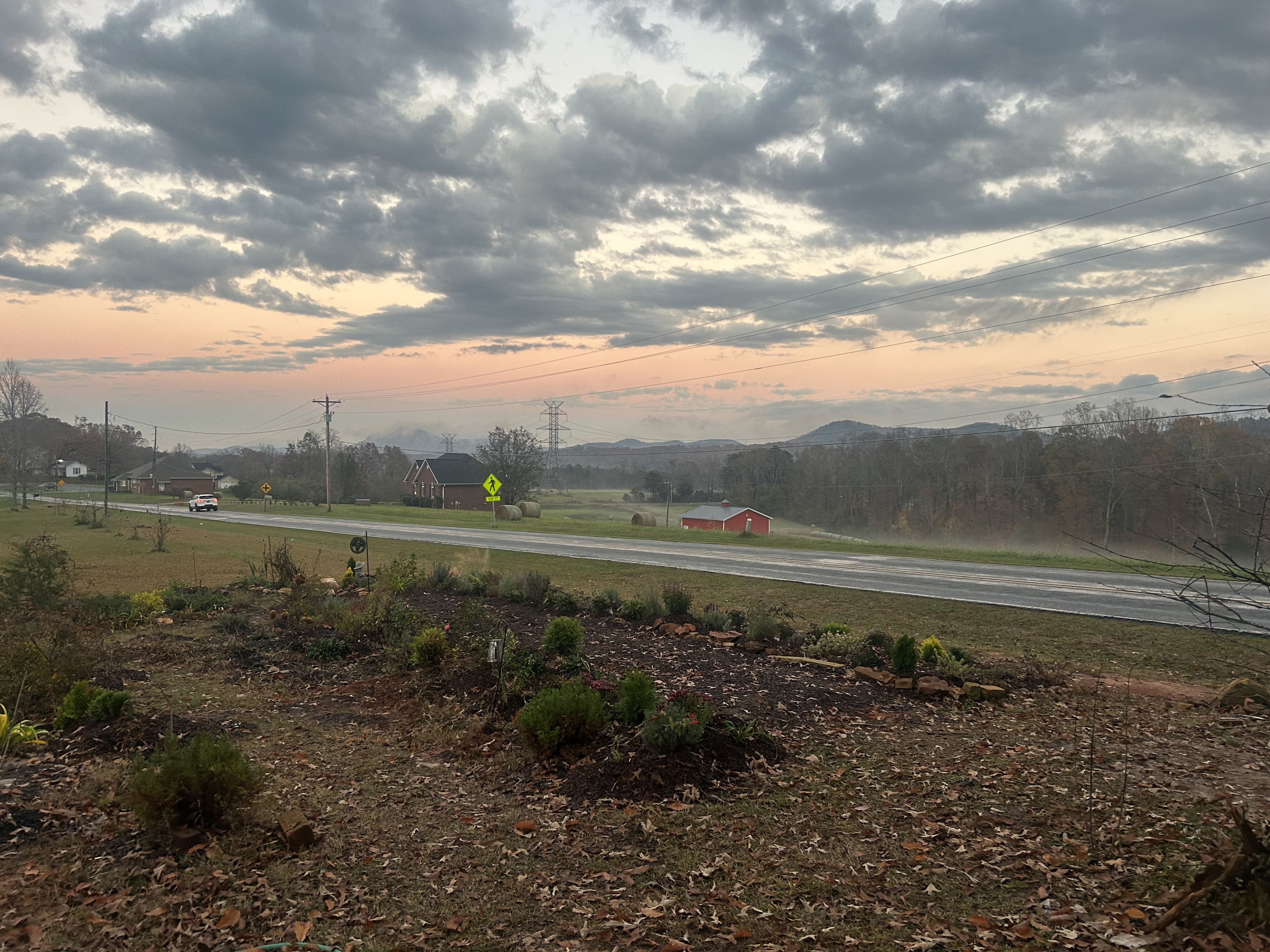
I thought about my grandparents as I made a sunrise video for TikTok, and added the Bing Crosby and David Bowie Christmas song to it. I thought about how much I still miss them. I thought about how my Papa taught me the difference between a poisonous and non-poisonous snake in a National Geographic magazine while he was in the hospital for the last time. My Papa was a man of Science—a great chemist—and a man of faith.
I could not read well, and I had a stutter. My paternal grandmother got me “Hooked on Phonics,” and required me to read aloud newspaper clippings until my pronunciations were right.
She was an elementary school teacher. When her students could not read during the Great Depression, she took her students to have their vision checked. Sometimes she bought glasses for them.
I have written here little about faith at all because it was my grandparents’ lives and actions that modeled a Christian life for me. The most I knew about my paternal grandmother’s personal Christian theology was that she believed in actions through faith. She did say she would never sing in church because she claimed her singing voice was horrible.
My maternal grandfather perhaps was a model Methodist man. He was an usher, and served a lot in the church. I heard him say little about the Bible, but his example—like my Dad’s parents—kept me identifying as a Methodist in these four-and-a-half-years since Corrie’s sunset. He often served at the Oliver Gospel Mission for those who are homeless in downtown Columbia, SC.
Mimi
My maternal grandmother, who wonderfully still walks in the world with us, had more influence on my life, perspective of faith, and political views than anyone else. She is far more outspoken than me. This comes as a surprise to no one who knows her.
I stayed with her for long periods of time, and she taught me that faith is extremely private. “Rebecca, you don’t speak about **x, religion, and politics” at the table. I have heard politics and **x spoken about at the family table at different times through the years, but religion remained private.
It is intimate in a similar way as the way your loved one moves the hair from the back of your neck and kisses your shoulder. The inner most theology, beliefs, and thoughts of scripture are private. I heard this more times through my youth from Mimi than perhaps her other inspirational quotes.
I set my boundaries and personal and public beliefs by my grandmother’s words. I learned to cook because of her. She injected a practical way view of the world in me that my parents, both of whom I love and adore, somewhat lacked.
But I observed her during one of the hardest times in her life when my grandfather went to the hospital with a stroke. It was unexpected, and he was not old. He was a healthy man, but he had told my Mimi a long time ago that he did not expect to live a long life because the men in his family died younger. Mimi worked as a bookkeeper at the high school, continued to act and sing in the play, and went to the hospital.
I spent most weekends during that fall through November in the ICU. I waited for my Gramps to speak, and at first he did through one side of his mouth. I came to understand what a stroke meant. As I wrote in my poem, I struggled with social connection due my neurodivergence, but I felt deeply for others. I wanted to show it without people misunderstanding or judging.
After his sunset, my Mimi expressed thoughts of anger towards God. I was with her after Christmas. I remember how she still pushed forward with a lone child in the house at that exact time. I recall then how empty the house felt, but how her anger filled the space he had left.
Her faith entered limbo, as mine would decades later.
Perhaps this is why my Mimi is my most memorable example of faith. She is real and human. I came of age at a time when I saw her beauty, strength, and flaws all at the same time. The other 3 became legends and myths of the sky, and I always looked for them. Mimi stood right in front of me as a testament of how to move forward when your heart is utterly broken.
A Very Poor Congregant
I was never the best congregant growing up because as a young child I fell asleep. Before I was diagnosed with ADD in the second grade, I became so bored in church. I never heard a message because I often looked at the stained glasses studying the portraits of the holy men and women. If I was awake, I held my hand up to the light rolling my fingers around in it.
My parents tell the story of when I was 2 or 3-years-old and they attended a family member’s funeral with me. A Baptist minister gave an ongoing sermon at the graveside. The louder he preached, my parents said, the louder I snored.
I drew on the pamphlets and often drew or wrote poems. I picked the half pencils out of the pews, and wrote anything I could. Parts of stories and novels came home from church with me, so I could write them in a notebook or type.
Finding Faith in the Songs
I became an usher as a teen just so I could move around during the service a little more than the mid-service meet-and-greet. But I always sang, unlike my paternal grandmother, and selected my favorite hymns. I knew the songs from the Methodist church both from the traditional book and the contemporary praise song book.
“For the Beauty of the Earth” was one of two hymns I chose for our daughter’s funeral.
"For the beauty of the earth,
for the glory of the skies,
for the love which from our birth
over and around us lies."
~ for The Beauty of the Earth

It touches on the celebration of nature in the words: "the glory of the skies," and "hill and vale and tree and flower" from the second verse. I came to think of God in the Earth where we had heartbreak, nature still produced growth.
I often think of this song when I work in the gardens, and consider the different memories of my grandparents, along with my little girl.
I chose another song “Lord of the Dance” for her funeral. The two men at the funeral home did not know this song, and my husband, who grew up Southern Baptist and changed to Methodism in his adulthood, told me it was not in the Baptist hymnal. The key word “dance” because some branches of the Baptist denomination disbelieve in dancing. John explained to me once he became an adult he learned to dance for this reason.
This song also celebrates life with the heartbreak that the death brings. It ends with the hope of the resurrection.
"I danced in the morning
When the world was begun,
And I danced in the moon
And the stars and the sun,
And I came down from heaven
And I danced on the earth,
At Bethlehem
I had my birth."
~ from Lord of the Dance

I still sing the lyrics when I am outside because it touches on the darkness before a return to the light.
Acknowledging Issues in Christianity
There are multiple challenges surrounding Christianity now. There is a divide in some Methodist churches across the nation. People have left the church. To disregard these truths means ignoring the problems. I do not believe nor support Christian nationalism sprouting like weeds in a garden seeking to choke the daisies. This is not what Jesus supported.
An important lesson I believe from Methodism includes something seldom spoken of: grace. There seems to be this hardline, and I remember grace. The Methodist church believes to “serve people around the world” and through grace. Humility and humble I come because I know there are those greater than me.
My Children
As you read, you may notice how little I actually mention scripture. This core part of any faith is private. I went as far as I could with the words given to me. But my faith in God and Christ came through the examples of acts and service through my grandparents, parents, and my children.
Yes, my children were more vocal in their faith than I ever was. Corrie played contemporary Christian music on her radio. I turned it off one day after she died, and never wanted to turn it on again. I did not change the radio station either. Eventually, I gave her radio to our son, her older brother.
Final Word
A former student sent me an email at the beginning of the school year. She said that it is because of me she established a relationship with God. She became a Christian.
Did you know I never once spoke of my faith or God? I say that not as a way to brag because I believe in coming to the cross with humility, but as a fact. I believe that is the way my grandparents would have me act.

 Corrie's Season